
Is it worth investing in property? Generally, property can be a worthwhile, long-term strategy, especially if you prioritise cash flow, tax efficiency, and steady income.
We understand that recent changes, including tax changes for buy-to-lets and the Renter’s Rights Act, could sway your decision on whether to invest in property — but we’re here to assure you that successful property investment is still entirely possible.
To find out more about whether it’s worth investing in property, reasons why it’s a good idea, and key property types providing the best returns, continue reading.
Property may be a good idea for investors focused on long-term growth, rental income, and leverage.
The current market is supported by a limited housing supply and strong rental demand across the country, which is encouraging news for investors. However, like all investments, success depends on your strategy.
Leverage allows you to borrow a certain amount of money as a mortgage to fund your investment property.
Essentially, this means more control of your property asset without having to use too much of your own cash. As your property grows in value, your equity is likely to increase compared to a full cash payment.
Property is a long-term investment that gives your asset more time to grow in value while also generating income, which can help to ensure stable returns.
Unlike many short-term investments that depend on the market, property typically appreciates over time, smooths out volatile periods, provides additional income as rents increase, and provides flexibility to manage potential risks.
Rental income and capital growth are two of the biggest drivers of returns when it comes to property investment.
They provide cash flow appreciation, which provides a reliable stream of income and long-term wealth. Both work together to sustain the investment while the property continues to appreciate over time as you build value.
A recent article by Savills states that the UK will build far fewer homes than the government’s target of 300,000 per year. While housing delivery has averaged around 230,000 homes a year, it’s now expected to fall below that.
However, this could be good news for investors. When fewer homes are being built, demand must be met by existing homes in the country, which tend to keep rents firm for good capital growth and rental income.
While we’re experiencing a housing shortage, more people may need to rent for longer, allowing for faster letting and reduced void periods.
According to Zoopla’s recent Rental Market Report, the average rent is now £1,321, up 2.1% over the last year due to demand. For investors, this is positive as it means stable rental income, lower risk of rent cuts, and a market that’s more predictable than it was a couple of years ago.
According to data from the Office for National Statistics, private rents and house prices over the years between 2016 and 2026 show hopeful results for investors.
The two lines compare annual inflation over time. The UK HPI line shows how fast house prices are rising each year, while the PIPR line shows how quickly private rents are rising each year.
Let’s take a look:
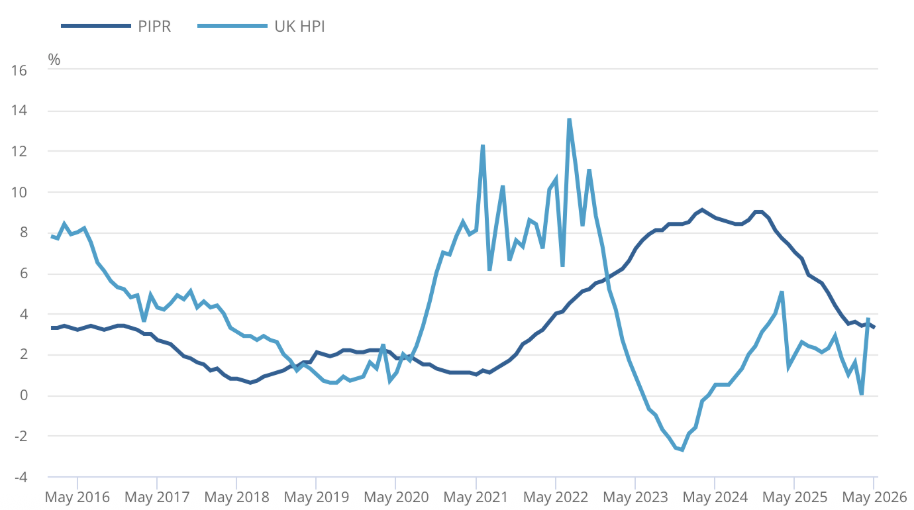
In summary, the chart suggests the property market still has life, with house prices continuing to rise and rents remaining steady.
But what does this mean for investors? House price inflation has picked up while rent inflation has eased, showing hope for long-term property investments and returns, only with the right strategy and location.
Buy-to-let, Houses in Multiple Occupation (HMOs), and student accommodation are key types of property investments, providing attractive returns and steady income due to high demand.
Buy-to-lets have proven to be a popular property investment, and all for good reason. They provide regular rental income and long-term capital growth, often allowing investors to enter the market with a deposit rather than paying in cash outright.
HMOs typically generate a higher rental income than traditional buy-to-lets. While the responsibility of HMOs takes up more time and money due to the increasing number of tenants, it can work in your favour by providing superior cash flow and a lower risk of void periods.
Demand for student accommodation is likely to remain high across towns and cities, especially Liverpool, Bath, London, Coventry, and Derby, as revealed by a recent UniHomes study.
This offers reliable tenant demand, great rental yields, and an easy target market, making it an appealing property investment if you’re seeking steady returns.
At Peninsular Property, we offer expert support for investors. Our highly experienced team assists both first-time landlords and experienced property investors with growing portfolios.
Whether you’re considering your first property investment and want to understand if it’s worth it, or you’re a seasoned investor looking to maximise your returns and make your investments worth it again, we’re here to help.
Together, we can ensure your property investment is worth it. Contact our friendly team today to learn more about our services.
Saving money is generally safer and more flexible, whereas investing money in property offers higher long-term growth and income. The best choice depends on your financial goals, timeline, and risk tolerance.
Yes, rental income from property can be a reliable revenue stream, as people in the UK always need housing. However, it’s important to remember that it’s not always guaranteed due to potential void periods and cost changes.
Yes, you can invest in property with no experience, but it may be difficult. We highly advise beginner investors to set budgets, learn about taxes, and gain a clear understanding of the property market before investing.
Yes, buy-to-let is still worth it after the recent tax changes, but only if your numbers still work out after mortgage costs, taxes, and compliance.
While updates to Stamp Duty Land Tax (SDLT), Capital Gains Tax (CGT), and Property Income Tax have reduced the appeal for some landlords, it’s still possible to invest successfully.
Joe is the founder of Peninsular Property and has worked in the industry since 2005. Joe has negotiated on over 9 million pounds worth of property purchases and managed over 1000 properties for clients all over the world. Joe is a landlord himself with a varied property portfolio so is ideally placed to advise clients on their property purchases and investments.
| Title | Price | Status | Type | Area | Purpose | Bedrooms | Bathrooms |
|---|